
Alexander Amir
Alexander Amir - Liberty's Grid A Founding Father A Mathematical Dreamland And The Shaping Of America - Hardcover
Alexander Amir - Liberty's Grid A Founding Father A Mathematical Dreamland And The Shaping Of America - Hardcover
Books
Regular price
$23.46 USD
Regular price
Sale price
$23.46 USD
Unit price
per
Shipping calculated at checkout.
Couldn't load pickup availability
Binding: Hardcover
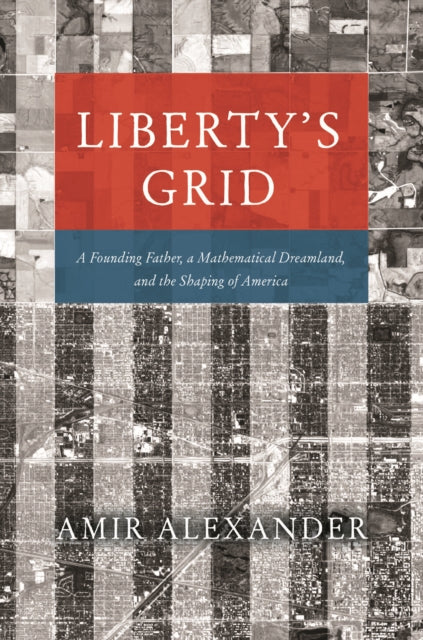
Description: The surprising history behind a ubiquitous facet of the United States: the gridded landscape. Seen from an airplane much of the United States appears to be a gridded land of startling uniformity. Perpendicular streets and rectangular fields all precisely measured and perfectly aligned turn both urban and rural America into a checkerboard landscape that stretches from horizon to horizon. In evidence throughout the country but especially the West the pattern is a hallmark of American life. One might consider it an administrative convenience an easy way to divide land and lay down streets but it is not. The colossal grid carved into the North American continent argues historian and writer Amir Alexander is a plan redolent with philosophical and political meaning. In 1784 Thomas Jefferson presented Congress with an audacious scheme to reshape the territory of the young United States. All western lands he proposed would be inscribed with a single rectilinear grid transforming the natural landscape into a mathematical one. Following Isaac Newton and John Locke he viewed mathematical space as a blank slate on which anything is possible and where new Americans acting freely could find liberty. And if the real America with its diverse landscapes and rich human history did not match his vision then it must be made to match it. From the halls of Congress to the open prairies and from the fight against George III to the Trail of Tears Liberty's Grid tells the story of the battle between grid makers and their opponents. When Congress endorsed Jefferson's plan it set off a struggle over American space that has not subsided. Transcendentalists urban reformers and conservationists saw the grid not as a place of possibility but as an artificial imposition that crushed the human spirit. Today the ideas Jefferson associated with the grid still echo through political rhetoric about the country's founding and competing visions for the nation are visible from Manhattan avenues and Kansan pastures to Yosemite's cliffs and suburbia's cul - de - sacs. An engrossing read Liberty's Grid offers a powerful look at the ideological conflict written on the landscape.
Title: Liberty's Grid A Founding Father A Mathematical Dreamland And The Shaping Of America
Author(s): Alexander Amir
Publisher: The University Of Chicago Press
Barcode: 9780226820729
Pages: 304 Pages, 26 Halftones, 6 Line Drawings
Publication Date: 5/29/2024
Category: History Of Engineering & Technology
Description: The surprising history behind a ubiquitous facet of the United States: the gridded landscape. Seen from an airplane much of the United States appears to be a gridded land of startling uniformity. Perpendicular streets and rectangular fields all precisely measured and perfectly aligned turn both urban and rural America into a checkerboard landscape that stretches from horizon to horizon. In evidence throughout the country but especially the West the pattern is a hallmark of American life. One might consider it an administrative convenience an easy way to divide land and lay down streets but it is not. The colossal grid carved into the North American continent argues historian and writer Amir Alexander is a plan redolent with philosophical and political meaning. In 1784 Thomas Jefferson presented Congress with an audacious scheme to reshape the territory of the young United States. All western lands he proposed would be inscribed with a single rectilinear grid transforming the natural landscape into a mathematical one. Following Isaac Newton and John Locke he viewed mathematical space as a blank slate on which anything is possible and where new Americans acting freely could find liberty. And if the real America with its diverse landscapes and rich human history did not match his vision then it must be made to match it. From the halls of Congress to the open prairies and from the fight against George III to the Trail of Tears Liberty's Grid tells the story of the battle between grid makers and their opponents. When Congress endorsed Jefferson's plan it set off a struggle over American space that has not subsided. Transcendentalists urban reformers and conservationists saw the grid not as a place of possibility but as an artificial imposition that crushed the human spirit. Today the ideas Jefferson associated with the grid still echo through political rhetoric about the country's founding and competing visions for the nation are visible from Manhattan avenues and Kansan pastures to Yosemite's cliffs and suburbia's cul - de - sacs. An engrossing read Liberty's Grid offers a powerful look at the ideological conflict written on the landscape.
Title: Liberty's Grid A Founding Father A Mathematical Dreamland And The Shaping Of America
Author(s): Alexander Amir
Publisher: The University Of Chicago Press
Barcode: 9780226820729
Pages: 304 Pages, 26 Halftones, 6 Line Drawings
Publication Date: 5/29/2024
Category: History Of Engineering & Technology